May 2026
10 years
The end of the month marked 10 years since I joined GDS.
I feel oddly embarrassed to have worked at the same place that long, but I think that’s just me internalising values about work that I don’t actually believe. If you’re mostly enjoying the work and don’t see anything more interesting elsewhere, why leave?
10 years is a long time though. I’ve been thinking a lot about when I first started. I was already a GDS fanboy – beyond excited to join, terrified I wasn’t going to be good enough. It was a step up. The level of pretty much everyone I worked with was so high and it was a really exciting environment. It was a very critical environment too, in good and bad ways to be honest.
I knew it was round the same time, but didn't realise that I joined less than a month before the Brexit referendum happened. Needless to say, the political context GDS was operating in became less stable for quite a few years. The organisation’s been in stronger and weaker positions at different points in that time, but it’s always attracted amazing people and had really interesting things to work on. I find it a bit overwhelming to think of everyone I’ve worked with in the last 10 years, in GDS and across government. Hundreds of them, all brilliant.
Thank you to the government design community who’ve made work feel less like work and kept me going at various points. And to Ste, Kate and Tim who thankfully saw something in the anxious lad in a yellow jumper sweating across from them in Aviation House just over 10 years ago.
Starting alpha
I wrote in previous months about our discovery on how users manage government communications they receive across different services and channels. Well, alpha is properly underway now. Betty and Sally joined the team and are doing an amazing job already, bringing prototypes, plans and opinions.
I’m doing various bits to make sure we join up with other design work happening, particularly on notifications. The GOV.UK App will fail if people get useless notifications all the time, we need to make sure that doesn’t happen.
Risky assumptions
We’ve been writing down our riskiest assumptions to prioritise which things to tackle first in alpha. In general I like using this method early on to de-risk projects and help you test the most important things earlier. But I find a couple of things hard to work with too.
Firstly, I struggle a bit with the language of it all. You start writing things like “we assume that X will happen”, which often includes things you don’t actually think will happen but need to record somewhere so you don’t miss it. Every ‘risky assumptions’ meeting I’ve ever been in has had people writing things in a different format, I suspect because it sometimes doesn’t match how people actually think about things.
Secondly, through doing lots of service assessments I’ve seen teams use riskiest assumption testing as the main method throughout a discovery/alpha phase, and find that at the end of it they’re not sure what to do next. You end up with all these tests and experiments and answered questions. You know lots about what you’re not going to build. But it doesn’t by itself lead you to a coherent product or service. GESTALT.
I drew this the other day to try and get across how the type of design and research work we do in alpha might change as we progress through it:
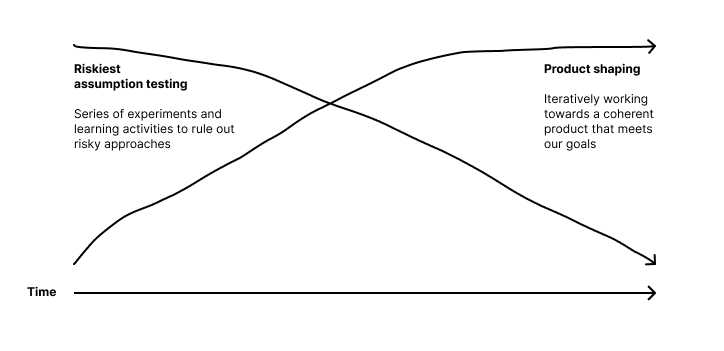
Vague and vibes-based but useful for me at least.
Design in the news
Strange South Yorkshire bent to this month’s mainstream design stories.
- Sheffield designer accused of using AI for Eurovision logo
- How Doncaster Sheffield Airport could look when it reopens